
Children’s reading is a subject very close to my heart. I have a primary school-aged son, so I see first hand the difficulties and distractions faced by children and parents when faced with the task of not only learning to read, but continuing to read… and enjoying it.
Books now have to compete with media. but in this case, it’s not just how a child or parent discovers a new book online, it’s the fact that for some, in the ever-increasing digital world of iPads and tablets, books aren’t exciting enough, or interactive enough, to warrant the same attention as a game of Jetpack Joyride, or Cut the Rope.
This does apply in my house at times, but fortunately – when really encouraged – my son does love to read, and be read to, and will choose print over digital every time. As Sam Missingham points out in her tweet from the Society of Young Publishers Conference 2013 (#syp13) ‘too often, reading is seen as the dullest thing a child can do on a tablet.’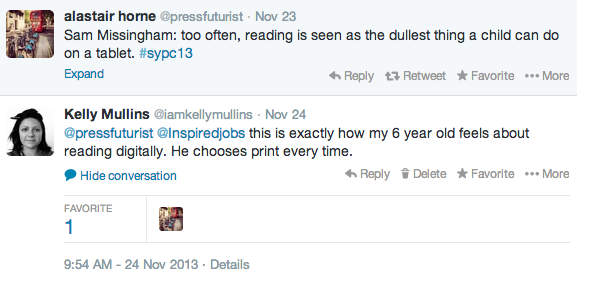
… I concur.
In June 2013, Nielsen carried out a survey of 2000 British children and parents – ‘Understanding the Children’s Book Consumer in the Digital Age‘. They reported that 50% of family households now own at least one tablet, up from 24% a year ago. With digital devices on the increase. we all know how easy it is to be totally engrossed once you’re using one, but are children being engrossed with ebooks once they’re on theirs? No.
As The Bookseller reported from their Children’s Conference – ‘The devices are being used for a range of activities, but reading is considered one of its least important uses. Only 20% of children use tablets for reading e-books, while 6% use them to read magazines and comics.’
 And according to Scholastic, ‘In terms of children’s attitudes to reading, 34% read books for fun 5-7 days a week, down from 37% in 2010, with watching DVDs, TV or video the most popular activity, done five to seven times a week by 67% of children, down marginally on 68% in 2010.’
So if a child’s reading habits have altered and there’s a decline in reading for fun, how is the publishing world adapting and addressing this?
Deborah Forte, president of Scholastic Media reports they have recently launched Storia, their ereading app, along with a book fair app that is meant to help parents and kids connect with print books at book fairs. The latter was downloaded 55,000 times within the first two months.
At the Digital Book World Conference 2014, she says –
‘How do we re-imagine reading electronically so that kids are engaged and fully inspired — all those things we do with print books, is there a way to do that electronically?… ‘One of the things someone in this room will hopefully do is invent a new digital reading format.’
But is the lack of a new format the only problem? Some believe the increase in digital products has created a lack of attention span for reading, so should we not be delivering content creatively to address this? Short bursts of chapters delivered in a way that makes a child feel they’ve just completed a new game level, for example? Or do we, as Hernán Casciari – founder and director of Orsai magazine – believes, re-develop stories to make them more relatable in this digital age?
In a Publishing Perspectives article, he cites the example of reading ‘Little Red Riding Hood’ to his young daughter, ‘who has a complete lack of awareness of or nostalgia for the analog world,’ and who pointed out that the main character could have simply sent a text message to her grandmother. He says –
So a lot has changed, and a lot needs to change in order that children maintain a love of reading – regardless of whether it’s print or digital. I personally think a closer look at a child’s learning style is needed to enable a more personalised reading experience, followed by a multi-element approach involving publishers, digital content creators, parents, teachers and libraries. Working together with one aim would surely see a bigger benefit.
For further information about Scholastic’s views and approach, watch this video interview with Deborah Forte –

 Editorial & Digital Content Services